
Standards directory · Define scope and verify evidence
RF PCB standards verification begins by identifying what the document covers and how it applies to the order. Use this directory to organize design, material, bare-board, assembly and supplier-evidence questions. It does not declare RFPCB certified to a standard or assign a compliance class to your project.
List the applicable standard, revision, classification, addenda and acceptance evidence in the controlled project package. Distinguish material specifications, board performance, assembly requirements and management-system certificates. Verify scope and current documents with the issuing organization and supplier before treating any claim as applicable to your order.
Keep different kinds of requirements separate
| Requirement type | Verification task | Related RFPCB resource |
|---|---|---|
| Design and drawing | Identify applicable document, revision and project deviations | Design brief |
| Laminate identity | Verify named grade, property method and purchasing specification | Material selection |
| Bare-board acceptance | Define performance/inspection scope and evidence | Quality review |
| Assembly acceptance | Specify assembly requirements and inspection basis | RF assembly |
| Supplier certification | Check issuer, validity, legal entity, site and scope | Factory and supplier review |
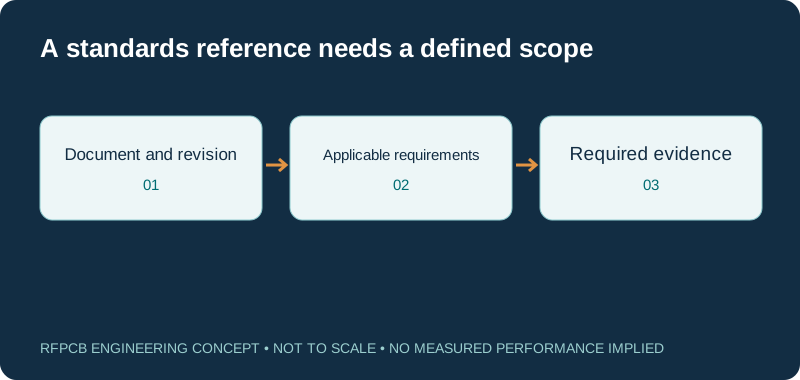
Identify the purpose of the document
Start by deciding whether the requirement governs design, laminate material, the bare board, an assembly or the supplier's management system. The IPC document directory helps identify titles and revision references. A standards number by itself does not show which clauses, classifications or addenda the project needs. Record the applicable scope in the controlled requirements package.
Review bare-board standards against the construction
IPC-6018 addresses qualification and performance for high-frequency microwave printed boards. Its official contents document is a starting point for identifying subject matter, not a substitute for the governing standard. Use quality review to discuss the requested evidence. Agree the applicable revision and requirements rather than automatically assigning a class from the product's industry label.
Keep material data separate from acceptance limits
A manufacturer datasheet can contain typical properties that are useful for selection without defining every procurement limit. Use the material guide to retain exact grade and method information. Identify the material specification governing the order and resolve differences with the supplier. A catalog value or family name should not silently become a guaranteed finished-board acceptance criterion.
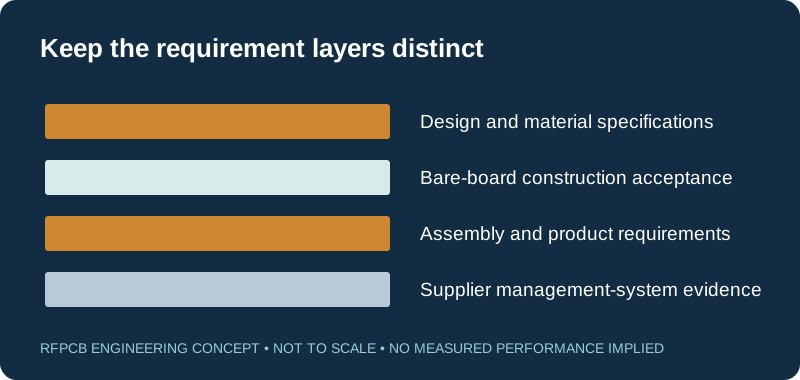
Specify assembly requirements independently
For populated boards, consult RF PCB assembly. IPC identifies J-STD-001 with soldered assembly requirements and IPC-A-610 with assembly acceptability in its official standards and training overview. Determine the required documents, revisions and product-specific instructions for the assembly scope. Bare-board acceptance alone does not establish that the populated product meets those requirements.
Verify certificates as documents with boundaries
Ask for the actual certificate when a management-system or other certification is required. Check the legal entity, site, stated scope, issuing body and validity rather than relying on a logo. ISO explains that external certification bodies perform certification. A management-system certificate should not be treated as proof of a particular board's RF response or product acceptance.
Connect standards to the requested report
Use the test-report guide to identify the samples, methods and limits needed as evidence. State which requirement each report addresses and how any uncertainty or deviation is handled. Avoid asking only for a “standard test report” without a defined scope. The useful result is a traceable connection between the order requirement, test procedure and delivered record.
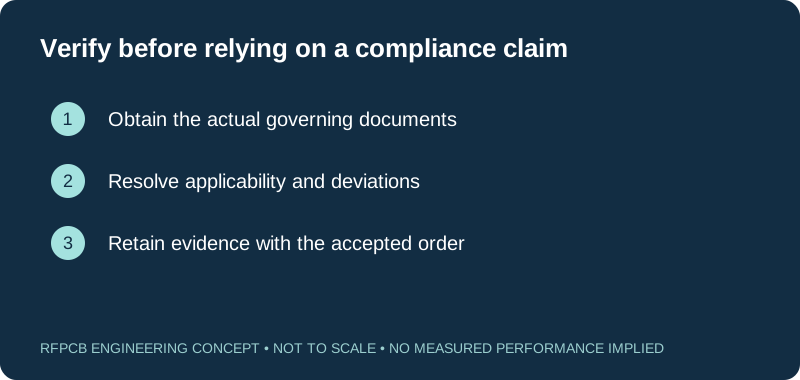
Resolve conflicts before manufacturing release
Bring drawing notes, customer specifications and proposed supplier deviations into one review. The DFM checklist helps expose missing or inconsistent requirements. Agree how conflicts are resolved and who approves exceptions. Do not assume a newer revision automatically changes an already approved order, or that a supplier's default instruction overrides an explicit customer requirement.
Retain a practical procurement evidence package
Store the accepted requirements, supplier response, applicable certificate copies and agreed report scope with the released revision. Use the factory review resource for supplier questions and project review for an order-specific request. This directory supplies a verification workflow, not a certificate register. Confirmation of actual certification and conformity must come from relevant, current evidence.
Prepare a reviewable engineering request
Check only the requirements you have actually documented. This list records readiness; it does not inspect your files or certify a design. Missing information is useful: identify it explicitly so the engineering review can resolve it before a production release.
These inputs are processed in your browser and are not submitted by this tool. The downloaded summary is a plain-text planning record. Use the secure quote form to send files; request an NDA first if your project requires one.
Manufacturing context
RFPCB and PCBSync share the manufacturing facility shown below. These process photographs illustrate the production environment; they are not evidence that a particular board, material grade or RF performance has been qualified. Request the documentation and inspection scope applicable to your project.



Standards and evidence questions
Does this page certify RFPCB to the listed standards?
No. It explains how to define requirements and verify evidence. Request current, applicable documents for any certification or conformity claim relevant to your order.
Is a management-system certificate a product approval?
It has its own stated scope. Do not treat it as proof of a specific board measurement or substitute it for the product acceptance evidence required by the order.
Should I always specify the newest revision?
Identify the revision required by the project and verify current publication information. Resolve contractual or customer requirements explicitly before changing the accepted specification.
Can the directory replace the standards themselves?
No. It is a navigation and procurement aid. Obtain the applicable documents and use their requirements with the controlled drawing, customer instructions and agreed deviations.
Continue your engineering review
Make the governing requirements reviewable
Provide the standards and revisions required for the project, along with drawings and customer instructions. Ask the supplier to identify applicability, evidence and deviations before the order is released.
Sources and engineering scope
- IPC official document revision and title directory
- IPC-6018D official contents: high-frequency printed-board performance scope
- IPC official overview of standards and certification training
- ISO explanation of certification and external certification bodies
- RFPCB quality, testing and evidence scope
- RFPCB test-report interpretation and measurement scope
Manufacturer values apply to the identified grade, test method and construction. Engineering examples on this page are illustrative; they are not measured product results, inventory statements or certification claims. Manufacturer and product names belong to their respective owners. Keep the applicable datasheet revision with your approved manufacturing package.
Ready for a quotation?
Send your requirements for a material, stackup and manufacturing review. Price and schedule are confirmed for your project.