
Procurement and engineering · Evidence-based supplier review
Use this RF PCB supplier qualification checklist to evaluate whether a proposed manufacturing route can support your defined board and acceptance requirements. Request linked evidence for material identity, construction, inspection and measurement. Record unresolved items and their owners so a supplier decision rests on reviewable records.
Qualify the manufacturing site and process scope against a representative construction. Follow a sample from incoming laminate identification through production, stackup verification and final reports. Agree how changes, nonconforming material and repeat orders are controlled. A brochure, certificate image or successful unrelated board is not enough to establish that chain.
Ask for evidence that answers a specific qualification question
| Review area | Evidence to request | Question the evidence must answer |
|---|---|---|
| Material identity | Receiving record, supplier documentation and laminate identifiers | Can the exact approved grade be connected to the build? |
| Production genealogy | Traveler or equivalent record linked to panel and shipment | Can the sampled boards and coupons be traced through processing? |
| Stackup and geometry | Approved stackup, measurement records and representative microsections | Does the manufactured construction match the reviewed definition? |
| Electrical acceptance | Test plan, identified data, limits and method settings | Which requirement does each result actually verify? |
| Change control | Example notification, impact review and approval record | Can a sourcing or process change reach production only under the agreed rules? |
| Nonconformance handling | Segregation, disposition and corrective-action records | Can affected material be contained and recurrence investigated? |
| Repeat production | Defined sampling, retention and review responsibilities | Will the agreed evidence remain available for later orders? |
Define the qualification scope before requesting documents
Name the manufacturing site, board type and process route under review. Record the intended materials, layer count, critical holes, conductor geometry, operating band and acceptance needs. Identify which activities the supplier performs and which rely on another facility or outside laboratory. Qualification of a two-layer RF coupon does not automatically establish a multilayer construction with different bonding, holes and assembly exposure.
Create an evidence register with fields for requirement, requested record, sample identifier, reviewer, status and open action. Use statuses such as reviewed, supplied but unreviewed, missing and outside the agreed scope. Avoid turning a large number of checked boxes into an automatic approval score. Decide which gaps prevent release and which can be closed during a defined trial. The DFM checklist helps establish a concrete design package for this review.
Trace a laminate lot through receiving and production
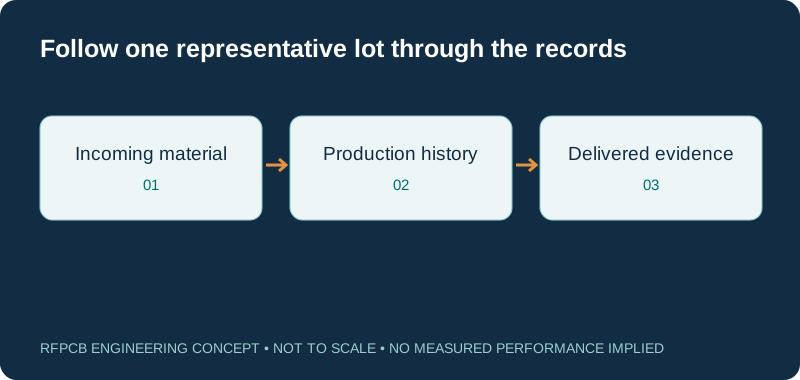
Ask for a demonstration using one representative, appropriately shareable sample. Start with the material manufacturer, complete grade, thickness and foil identification, then follow the lot or sheet identifier into receiving inspection and the production record. Continue to the panel, coupon, finished-board identification and delivery documentation. Request the retention period and the method used to retrieve the records later.
Rogers' RT/duroid receiving guidance illustrates manufacturer labels and recommends preserving material identity through processing. The qualification question is whether the supplier can maintain the relevant chain for your construction. A stock photograph of a branded sheet proves little about the boards being offered. Accept redaction of unrelated customer details when necessary, but retain enough linked identifiers to evaluate the process.
Examine incoming acceptance and substitution controls
Review what happens when delivered material does not match the purchase requirement. Ask how receiving checks the complete designation, thickness, cladding and applicable supplier documentation, and how questionable material is identified and segregated. Include storage conditions or shelf-life control where the specific product requires them. Do not impose one storage rule on every core, prepreg and bonding film.
Then test the decision path with a practical scenario: the requested laminate or foil is unavailable. Request an example of how an alternative is proposed, evaluated and approved before use. The response should name the changed attributes, affected orders and approving authority. A statement that two materials are “equivalent” is not a substitute for that review. Confirm that accepted incoming material is still checked against the released construction rather than merely against a broad family name on a purchasing line.
Compare the proposed stackup with measured construction
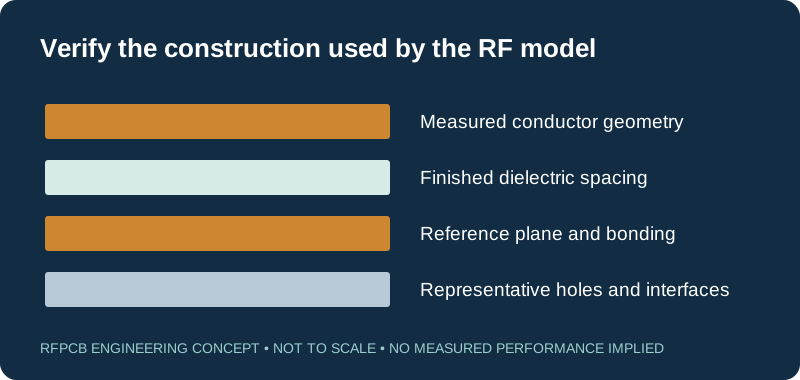
Request the approved stackup and the dimensions used in impedance or RF modeling. Identify core and bonding grades, finished dielectric separations, copper thickness and sensitive trace geometry. Ask which values are nominal design inputs, expected process targets or measured results. The distinctions matter when evaluating a claim that the build matches the model.
Review representative measurements with layer labels, sample identity, units and measurement locations. A total board-thickness reading cannot establish every internal dielectric spacing. For bonded regions, compare the as-built measurements with the assumptions used at release; Rogers' 2929 processing guidance illustrates why pressed spacing depends on the construction. Where a difference is allowed, request the engineering disposition and any model update. The controlled-impedance guide provides context for tying geometry to electrical acceptance.
Check that coupons and microsections represent the risk
Ask why the selected coupon represents the important product features. Compare its materials, layer transitions, hole structure and geometry with the actual board. For a mixed stack, ensure the section or test article covers the interfaces under review. Request the location and orientation of each microsection, the sample identifier and the inspection basis. A clear image without this information may be impossible to interpret reliably.
IPC's microsection preparation method discusses laminate and plated structures, but a preparation method does not itself supply every acceptance limit. Agree the applicable performance requirements and specimen conditioning separately. Inspect whether the record distinguishes an as-manufactured sample from one subjected to a specified thermal exposure. Evaluate the selected evidence against the identified risk rather than assuming one attractive cross-section qualifies every hole type or later production lot.
Separate connectivity, impedance and RF measurements
Request a test matrix that maps each requirement to a method and deliverable. Continuity and isolation, controlled-impedance measurements and frequency-domain RF characterization address different questions. Identify which checks apply to each shipped board, which apply to sampled coupons and which belong only to the qualification trial. Sampling and acceptance thresholds should follow the agreed requirement, not be inferred from a generic “100% tested” statement.
For RF data, specify the operating band, port reference impedances, reference planes and connector or fixture treatment. Keep raw data and processed results distinguishable. Keysight's fixture-removal documentation explains why de-embedding changes the measurement boundary. Use the RF PCB test report guide to request the sample identity, settings, limits and result format needed to make the comparison reproducible.
Assess the measurement process, not only the instrument list
An equipment list can help identify possible methods, but request evidence of how the method is applied. Review instrument identification, calibration status at the test date, relevant standards or fixtures, setup settings and operator procedure. Ask how a reference sample or other check detects a setup problem before production results are accepted. Match instrument bandwidth and fixture behavior to the band and structure under evaluation.
NIST's traceability guidance explains that measurement traceability concerns results and their reference chain, including uncertainty. It is not established by a calibration sticker alone. Where measurements approach a limit, agree how uncertainty affects the acceptance decision. Distinguish material genealogy from this measurement question: both are valuable, but a laminate lot number cannot establish the quality of an impedance measurement, and an instrument certificate cannot establish the laminate used.
Review deviations, nonconformance and change notifications
Request a shareable example of an out-of-requirement finding and follow its handling. Look for identification of affected material, containment, technical disposition, customer communication where required and release authority. Separate permission to accept one bounded deviation from approval of a permanent process or design change. Ask how the next operator or repeat-order reviewer can see which decision applies.
Define notification and approval triggers for the project: material grade, foil, bonding construction, finish, manufacturing location, critical outside processing and acceptance method are candidates for review. Determine how a notice reaches engineering and purchasing, which stock or work in progress is affected, and when the change becomes effective. An incoming material change should be assessed before it is treated as a routine purchase substitution. Document the records or trial evidence needed to close each change.
Use a representative trial to resolve remaining uncertainty
Choose trial features that test the actual concern, such as the sensitive RF layer, relevant hole geometry, bonding interface or connector launch. Define the release revision, inspection articles, quantities and acceptance limits before the build. Keep the comparison controlled: if material, foil, layout and finish all change together, the result evaluates that complete construction rather than isolating one material property.
Agree who reviews the data and what outcome permits the next stage. A trial can produce approval, a request for additional evidence or a revised construction; it need not be forced into a binary sales decision. Retain failures and their disposition alongside successful measurements. For high-frequency board requirements, IPC-6018 is a relevant specification family to evaluate, but the contract must identify the applicable edition and project scope. This checklist does not assign compliance on the supplier's behalf.
Close the review with an approval scope and repeat-order rules
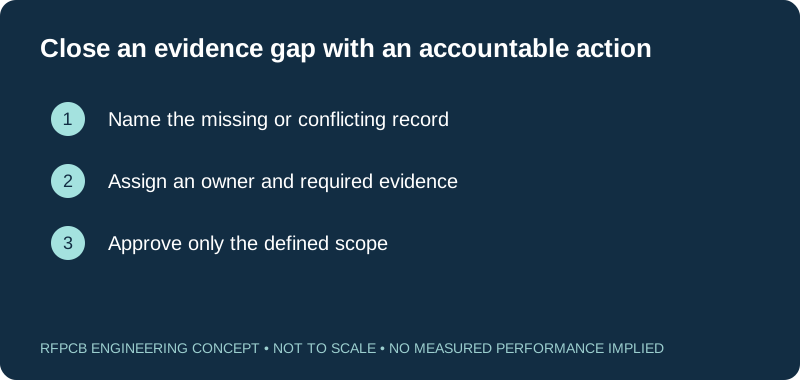
Record exactly what was evaluated: site, material system, construction, process route, test scope and any remaining conditions. Name the decision owner and keep the evidence register with the approved manufacturing package. If commercial or schedule assumptions remain open, show them separately from technical acceptance. A quoted date or unit price should not erase an unresolved requirement that changes the actual deliverable.
For repeat production, define report contents, sample selection, material-change handling, record retention and the events that trigger another review. Use the interactive checklist only to mark documented readiness; it cannot inspect records or certify a supplier. Download the summary and add evidence identifiers and action owners in your project notes. The factory review page and quality information page can help structure follow-up discussions, while the purchase package remains the controlling statement of your requirements.
Prepare a reviewable engineering request
Check only the requirements you have actually documented. This list records readiness; it does not inspect your files or certify a design. Missing information is useful: identify it explicitly so the engineering review can resolve it before a production release.
These inputs are processed in your browser and are not submitted by this tool. The downloaded summary is a plain-text planning record. Use the secure quote form to send files; request an NDA first if your project requires one.
Manufacturing context
RFPCB and PCBSync share the manufacturing facility shown below. These process photographs illustrate the production environment; they are not evidence that a particular board, material grade or RF performance has been qualified. Request the documentation and inspection scope applicable to your project.



RF PCB supplier qualification questions
Does completing this checklist approve a supplier?
No. It records the review areas you have documented. Approval requires an accountable decision against the specific construction and acceptance scope, with evidence gaps and conditions addressed.
Can the supplier provide redacted examples?
Yes, provided the remaining information demonstrates the relevant process and preserves the links needed for review. Do not request unrelated customer confidential information. If redaction removes the essential chain, arrange another suitable demonstration.
Is a material certificate enough to prove traceability?
It supports material identity, but the review also needs the connection from received material to production panels, coupons and delivered boards. Confirm that the record chain covers the actual order and construction.
When should qualification be revisited?
Define triggers in the approved package. Changes to material, foil, stackup, critical processing, manufacturing location or test method may require review. Recurring nonconformance or evidence that no longer represents production can also justify reopening the affected scope.
Continue your engineering review
Request a construction-specific evidence review
Share the intended board, critical requirements and evidence register. Identify which records need review, which trial questions remain open and who will approve the final scope.
Sources and engineering scope
- Rogers: RT/duroid 5870/5880 fabrication guide, receiving and material identification
- Rogers: 2929 Bondply multilayer processing guidance
- IPC-TM-650 2.1.1F: Microsectioning specimen preparation
- Keysight: S-parameter measurement definitions and port relationships
- Keysight: Removing Unwanted Effects from the Measurement
- NIST: Metrological Traceability, Frequently Asked Questions and Policy
- IPC-6018D official table of contents: high-frequency printed-board qualification and performance scope
Manufacturer values apply to the identified grade, test method and construction. Engineering examples on this page are illustrative; they are not measured product results, inventory statements or certification claims. Manufacturer and product names belong to their respective owners. Keep the applicable datasheet revision with your approved manufacturing package.
Ready for a quotation?
Send your requirements for a material, stackup and manufacturing review. Price and schedule are confirmed for your project.