
Shengyi RF materials · Family selection hub
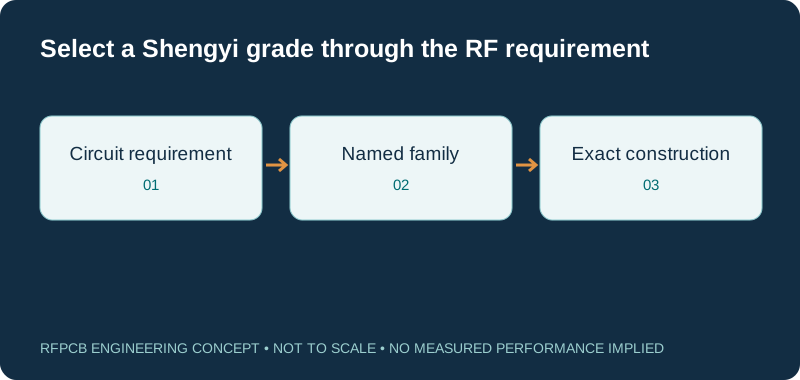
Shengyi high frequency PCB selection begins with a complete grade designation. The manufacturer supplies several RF material systems, including hydrocarbon/ceramic, PTFE-based and other thermosetting products. Use this family guide to reach the existing grade pages and define the construction behind your RF requirement.
Shengyi is a manufacturer, not a single dielectric formulation. Start with the RF function, choose a named material family and confirm the precise grade, suffix, foil and thickness. S7136, S7136H and SCGA-500 GF have separate review paths; matching a nominal Dk to another brand does not establish a drop-in replacement.
Navigate the Shengyi material families
| Starting point | Material identity to confirm | Next engineering step |
|---|---|---|
| S7136 | Keep the S7136 designation distinct from S7136H | Resolve the applicable grade document and construction |
| S7136H | Glass-reinforced hydrocarbon/ceramic material | Check method, foil variant and thickness-specific data |
| SCGA-500 GF | Glass-reinforced PTFE; retain GF220, GF255, GF265 or GF300 | Select one full designation and its process guidance |
| Other RF products | Manufacturer catalog also separates thermosetting and PTFE types | Obtain the exact current product literature |
| Proposed replacement | Named baseline and named Shengyi candidate | Compare the complete construction and RF evidence |
| Manufacturing request | Grade, foil, thickness, bonding and quantity | Confirm sourcing and DFM against the project package |
RF route loss budget worksheet
Total = length × entered attenuation + total launch/transition allocation + other passive loss. Frequency labels the scenario; it does not synthesize an attenuation model. Use comparable data at that frequency and avoid counting the same feature twice. Adding scalar dB terms is a matched or weak-reflection planning approximation; use cascaded S-parameters for mismatched structures. Default values are illustrative.
Use this page as a family map
A material request may arrive as “Shengyi RF,” a partial grade name or a proposed alternative to an existing board. Each is a starting point for clarification rather than a complete purchasing description. Shengyi's official RF catalog separates material categories and lists several distinct products. Follow the exact designation into the corresponding datasheet and processing guidance.
For the established site guides, continue to S7136 PCB, S7136H PCB or SCGA-500 GF PCB. This page explains how to choose between review paths and organize a request. It does not merge those grades into one specification. Keep the material name consistent across the drawing, model, quotation and incoming documentation so the engineering discussion remains attached to a real construction.
Define the application before comparing catalog rows
Begin with the circuit function and operating band. An antenna feed, amplifier matching network, receiver interconnect and narrowband filter can place different demands on loss, phase, impedance and mechanical stability. Describe the requirement in terms that a reviewer can evaluate: maximum path loss, permitted response shift, available tuning range or a defined dimensional envelope.
Then record the sensitive features and the reason material selection is being reconsidered. A new design seeking a practical stackup needs a different review from a released design facing a sourcing change. State whether artwork can be revised, whether connectors are fixed and whether previous RF evidence must remain applicable. The material selection guide helps turn these constraints into a comparison. It also helps identify when a grade-specific guide contains the detail needed for the next decision and when supplier clarification is still necessary.
Keep hydrocarbon and PTFE processing paths separate
Shengyi publishes a combined S7136/S7136H processing guide under its high-frequency hydrocarbon material category, while its SCGA-500 series guide addresses PTFE materials. Shared manufacturer ownership does not imply a shared process recipe. The material system matters when reviewing handling, hole preparation, bonding and the finished board.
Provide the layer count, hole schedule, copper and assembly requirements when asking a fabricator to evaluate either route. A generic statement that a material can be used for RF does not establish process approval for every geometry. For an alternative build, ask what construction details and process assumptions change. Retain those differences in the comparison record. The appropriate decision is whether a documented proposed build meets the project requirements, rather than whether one resin family is always easier or always better.
Read the test method beside each dielectric value
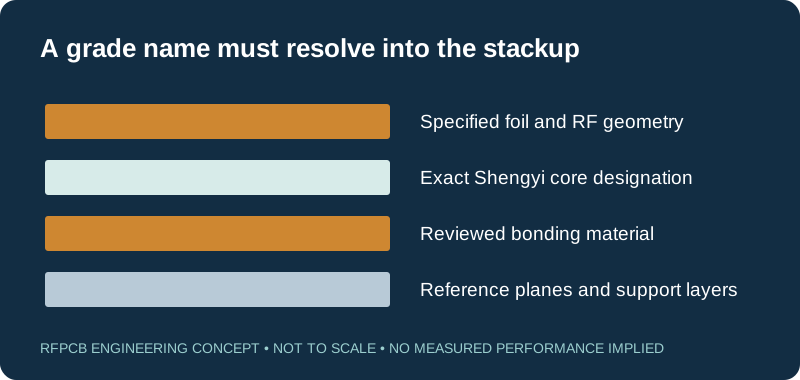
The official S7136H product table demonstrates why method labels matter. It lists process Dk 3.42 ± 0.05 and Df 0.0030 under IPC-TM-650 2.5.5.5 at 10 GHz/23°C, alongside SPDR values of 3.68 ± 0.05 and 0.0035. It separately identifies design Dk 3.61 using a differential phase-length method. Those entries must not be combined into an invented best-case property pair.
When building a comparison sheet, keep value, test method, frequency, conditioning and source revision in the same row. Use a model appropriate to the intended geometry, then check its correlation with the construction being quoted. A property table supports selection; it does not automatically supply every parameter for a field solver. Resolve differences between manufacturer documents explicitly instead of averaging numbers or silently choosing the one that makes a candidate look better.
Retain suffixes, foil variants and specimen context
A short material name can conceal an important construction change. The S7136H technical datasheet distinguishes a coated reverse-treated-foil variant and includes a thickness-related dielectric note. It also identifies the specimen basis for typical properties. Preserve those qualifications when translating a supplier proposal into an engineering model or purchasing description.
Ask for the exact foil designation and dielectric thickness, not only nominal copper weight and total board thickness. Confirm whether the quoted material matches the variant used in the existing model. If the supplier proposes another option, mark the change for review before the drawing is released. This discipline also applies within the SCGA-500 GF group, where the numerical suffix identifies a particular product. A family-level approval should never erase the specific material and construction that supported prototype acceptance.
Use the loss worksheet with measured or modeled inputs
The loss-budget worksheet adds uniform-route loss to the entered launch and other passive-loss allocations. It can help decide whether changing the laminate is likely to address the dominant concern. Enter attenuation from a relevant model or measurement at the selected frequency. The tool does not derive attenuation from the words Shengyi, PTFE or hydrocarbon, and its default entries are illustrative scenarios.
Record the source of each input and avoid counting a connector or via in both the route term and the transition allowance. Scalar loss addition is useful for an initial matched or weak-reflection budget. If reflections and interactions matter, review the complex network response instead. Keep the same measurement boundaries when comparing candidates. An apparent improvement has little meaning if one trace includes two launches and the other result has already had fixture effects removed.
Build a complete multilayer proposal
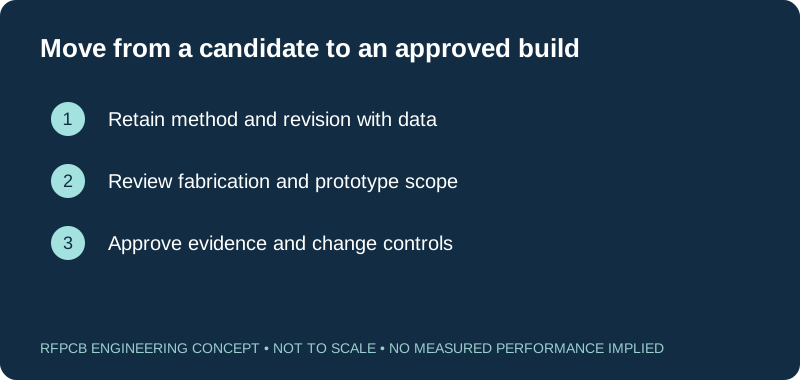
The RF core is only part of a multilayer construction. Identify bonding materials, pressed separations, reference planes and the route through any layer transition. Show where the RF fields encounter another material rather than assuming all relevant dielectric regions inherit the core's properties. Include copper distribution and the mechanical thickness requirement in the same package.
Use the hybrid stackup guide when RF and supporting functions may use different material systems. Ask the fabricator to identify its proposed combination and any details requiring confirmation. Shengyi's grade-specific processing guidance is a useful input, but the complete board still requires review. For a stackup revision, mark the layers and sensitive paths affected. This makes an engineering response actionable and reduces the chance that a bonding-layer change is accepted as a purely commercial substitution.
Evaluate alternatives with a controlled comparison
A replacement proposal should name the approved baseline and the candidate grade in full. State which parts of the construction remain fixed and which may change. Similar nominal Dk is insufficient when copper, thickness, dielectric test method, thermal response or processing differs. Define the acceptance evidence before treating a material as interchangeable.
Where feasible, use representative circuits and consistent measurement boundaries for both builds. If geometry must be retuned, retain the original and revised artwork so reviewers can understand what was compared. Record losses, phase or resonance behavior according to the actual application rather than selecting a convenient catalog parameter. Include engineering effort and qualification cost in the commercial decision. A lower laminate quotation may be valuable, but the delivered-board comparison also needs equivalent inspection, test scope, quantity and the cost of approving the new construction.
Make sourcing statements specific to the quotation
A manufacturer product listing establishes that literature is available for a named material; it does not confirm factory stock, allocated sheets or a delivery date for your order. Request sourcing confirmation for the exact grade, thickness, foil and quantity. Distinguish a standard catalog offering from the construction that can actually be proposed for the project.
For repeat production, define how material identity and approved alternatives will be recorded. If availability changes, ask for the proposed substitute and its affected assumptions in writing. Separate supplier commercial commitments from engineering acceptance. Do not use a previous successful order on one Shengyi grade as evidence that all grades and layer combinations are qualified. The useful procurement record joins the accepted drawing, material designation, supplier proposal and inspection scope so a future buyer can review changes without reconstructing the original technical conversation.
Prepare a request that can produce a useful decision
Submit the manufacturing files, proposed stackup and quantity through the project review form. Include the intended RF function and operating band, the complete material candidate and the issue that remains unresolved. If selection is still open, give the engineering team a short list of candidates and the constraints that determine success.
Attach prior measurement results when requesting a substitute for a released board, and identify the original construction clearly. Mark prototype versus production intent, required reports and any allowed artwork changes. Use the checklist below to distinguish documented requirements from open questions. The response should identify a construction, sourcing assumptions and an agreed verification path. A brand name alone cannot promise RF performance, but a well-defined material and test package gives engineering and purchasing a practical basis for choosing the next build.
Prepare a reviewable engineering request
Check only the requirements you have actually documented. This list records readiness; it does not inspect your files or certify a design. Missing information is useful: identify it explicitly so the engineering review can resolve it before a production release.
These inputs are processed in your browser and are not submitted by this tool. The downloaded summary is a plain-text planning record. Use the secure quote form to send files; request an NDA first if your project requires one.
Manufacturing context
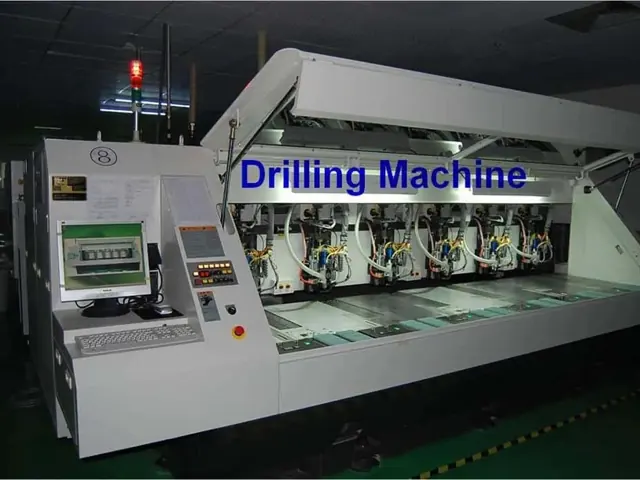
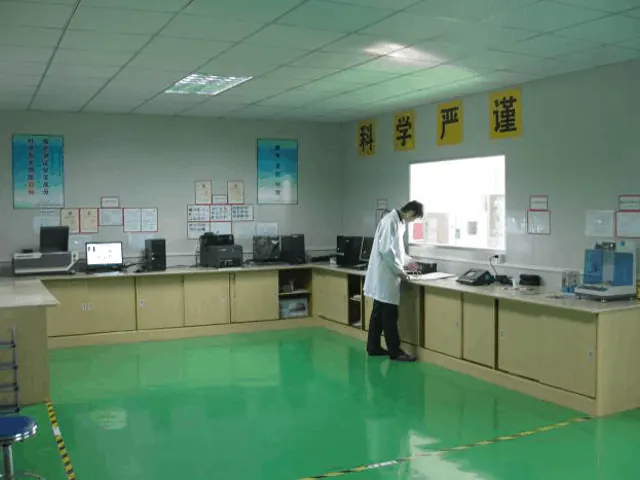
RFPCB and PCBSync share the manufacturing facility shown below. These process photographs illustrate the production environment; they are not evidence that a particular board, material grade or RF performance has been qualified. Request the documentation and inspection scope applicable to your project.

Shengyi high frequency material questions
Is every Shengyi RF material PTFE based?
No. The catalog includes different resin systems. S7136H is described as glass-reinforced hydrocarbon/ceramic material, while SCGA-500 GF products use glass-reinforced PTFE. Consult the exact grade document and processing guide.
Are S7136 and S7136H the same grade?
They have distinct product designations. Preserve the requested name and resolve its applicable datasheet, suffix and construction. A combined processing guide does not authorize copying every electrical value or substituting one grade for the other.
Which SCGA-500 GF material should I specify?
Specify the full suffix, such as GF220, GF255, GF265 or GF300, after reviewing the appropriate properties and construction. The family name alone leaves the material identity incomplete. See the dedicated SCGA-500 GF guide for the grade-selection discussion.
Is a Shengyi grade a drop-in replacement for Rogers?
That requires evidence for the named pair of constructions. Compare electrical models, geometry, copper, processing and the relevant RF measurements. Similar nominal Dk or a lower quotation does not establish equivalence or eliminate qualification work.
Continue your engineering review
Request a named Shengyi construction review
Send the full grade, foil and thickness with your RF requirements. If the material remains undecided, include the baseline and constraints so the proposal can explain the candidate construction and qualification scope.
Sources and engineering scope
- Shengyi official RF material catalog and product-family navigation
- Shengyi S7136H product data: process, design and SPDR references
- Shengyi S7136H technical datasheet CN-TDS-2210-01-S7136H
- Shengyi S7136/S7136H high-frequency hydrocarbon processing guide
- Shengyi SCGA-500 GF series high-frequency PTFE processing guide
- Shengyi Technology USA RF and microwave material overview
Manufacturer values apply to the identified grade, test method and construction. Engineering examples on this page are illustrative; they are not measured product results, inventory statements or certification claims. Manufacturer and product names belong to their respective owners. Keep the applicable datasheet revision with your approved manufacturing package.
Ready for a quotation?
Send your requirements for a material, stackup and manufacturing review. Price and schedule are confirmed for your project.